
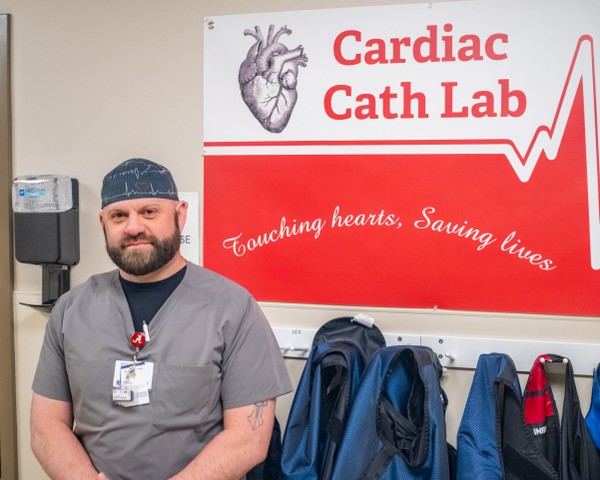
Showing Up When It Matters Most: Jarred Kato’s Life-Saving Act
What started as a quiet day off for Jarred Kato turned into a life-saving moment he never expected, but was fully prepared for.
Jarred, a Cardiovascular Technician at Great Falls Hospital, joined the organization in 2025 after relocating from Michigan to Great Falls, Montana. While newer to the community, he was very familiar with the area and frequently visited the shooting range near Highwood, where he chose to spend his day off.
As Jarred drove down into the valley toward the range, an area known for wide-open land and little to no cell service, he noticed a vehicle parked nearby. Inside was a man reclined in the driver’s seat with his window down and his eyes closed.
The man’s skin was gray, his appearance deeply concerning.
“There was no reason for him to be sitting there,” Jarred later said. “He just didn’t look okay.”
Trusting his instincts, Jarred pulled over and approached the vehicle to check on him. That’s when the man quietly told him he had accidentally shot himself and had no way to call for help.
Training Takes Over
Jarred immediately relied on his training and instinct.
Before joining Great Falls Hospital, Jarred served nine years in the U.S. Army, including deployments to Iraq and Afghanistan. During his service, he received extensive training in Tactical Combat Casualty Care (TCCC), skills designed to preserve life in the most critical situations.
Jarred opened the car door and saw that the bullet had entered near the man’s hip and exited close to the kneecap, causing severe bleeding.
His first priority was controlling the hemorrhage.
Jarred quickly applied a tourniquet high on the man’s right leg to slow the blood loss. With no cell service available and the injury clearly life-threatening, Jarred told the man to stay where he was and immediately drove uphill to find help.
Racing Against Time
Jarred told the man he needed to go get help and drove back up the hill toward the nearest house. At the top, he urgently knocked on the door, covered in blood and explaining that someone was dying.
A homeowner responded and came back down the hill with him, staying with the injured man while Jarred continued care.
Jarred cut open the man’s pant leg, laid him carefully on a shooting mat, and began packing the wound with quick‑clot gauze, applying steady pressure to help control the bleeding.
Emergency services were still difficult to reach due to limited cell coverage, and it became clear that first responders might struggle to find the location deep in the valley.
The homeowner brought her vehicle down so they could move uphill to meet help. Because the homeowner has a physical limitation, Jarred physically lifted the injured man into the back of the vehicle and held him upright throughout the drive to keep him stable, even leaving the rear hatch open to do so.
At one point, deputies and an ambulance nearly left without seeing them. The homeowner began sounding her horn repeatedly, alerting responders and prompting them to turn back.
By this time, the elderly man was fading. His speech became slurred, and he was no longer fully coherent.
A Life Saved
Emergency medical personnel transferred him to a stretcher and waited for a medical helicopter to transport him to advanced care.
Despite the severity of his injuries and the remote conditions, he survived.
After two to three days in the hospital followed by rehabilitation, he is now up, walking, and continuing his recovery.
More recently, Jarred reunited with the man and his family for dinner, celebrating something extraordinary: a life saved because someone stopped and knew what to do.
The Right Thing to Do
Jarred doesn’t consider himself a hero.
“I didn’t even think twice,” he said. “It was just the right thing to do.”
What made the difference that day was simple: someone showed up who had the training to act, even in a desolate area, with no cell service and no immediate backup.
Jarred hopes others learn from the experience.
“Everyone should know how to take care of themselves in emergencies like this,” he said. “Not just to save your own life, but to save someone else’s.”
He recommends carrying a basic first aid kit, including a tourniquet and quick‑clot gauze, and learning how to use them properly, tools that are widely available and can truly mean the difference between life and death.
Because of his actions and expertise, Jarred has since been asked to teach a tourniquet safety class at the shooting range, helping ensure others are prepared if something goes wrong.
Jarred may be somewhat new to Montana, but on that day, he showed exactly what it means to be part of a community, stepping in, staying calm, and making a difference when it mattered most.
At Great Falls Hospital, we are proud to work alongside professionals like Jarred Kato, people whose commitment to care extends far beyond our walls.
Disclosure: The individual whose life was saved gave permission for this story to be shared but asked to remain anonymous.